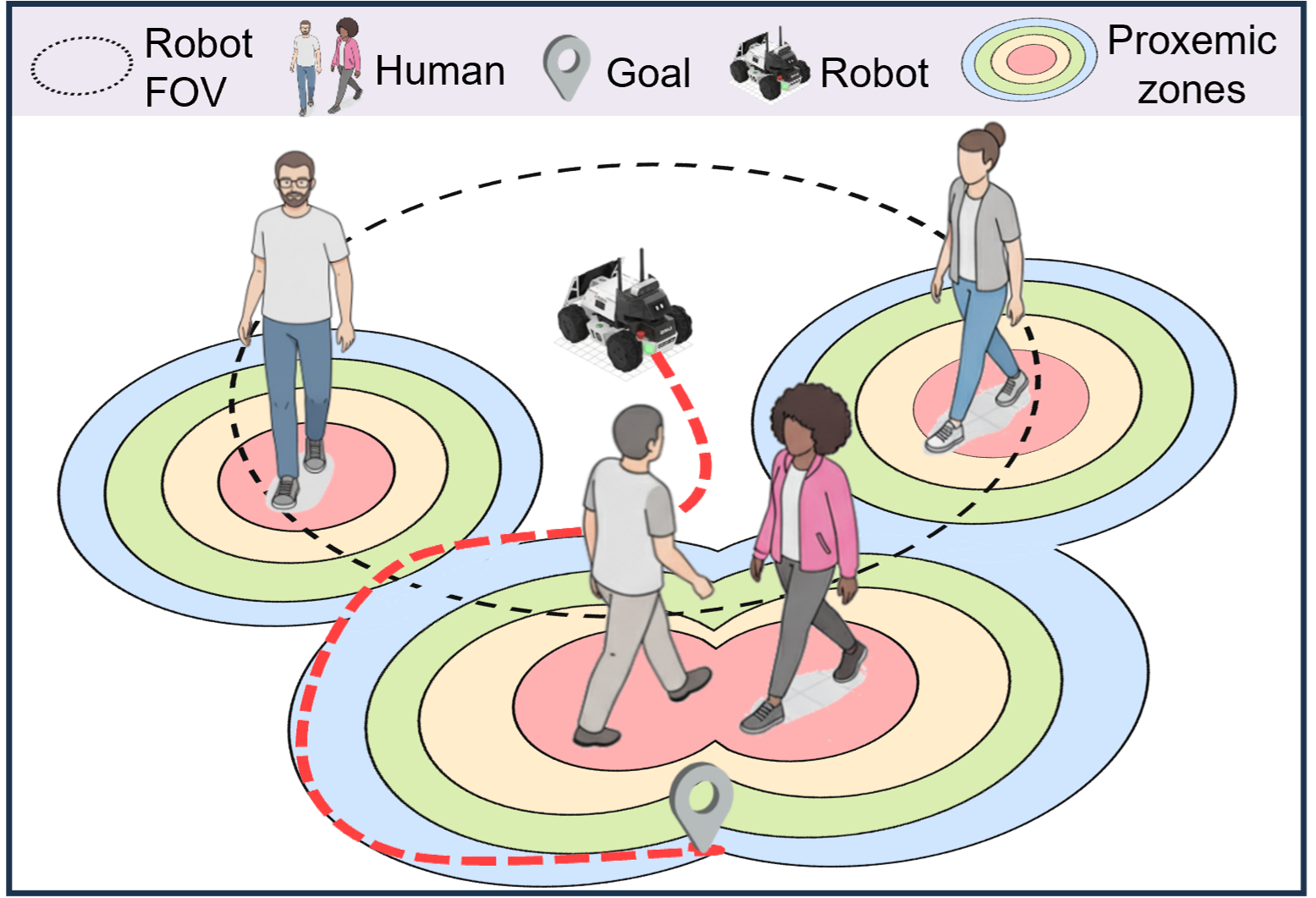
Developing effective robot navigation methods in crowded environments is essential for real-world applications. Although recent deep reinforcement learning (DRL) methods have improved navigation performance in crowded environments, they often focus primarily on task-centric objectives and underrepresent social compliance objectives.
In this paper, we introduce a novel proxemics-based reward formulation for DRL social navigation that provides a dense, interpretable social learning signal while maintaining navigation efficiency. Our approach models each human's personal space as a radial Gaussian-mixture field derived from Hall's proxemics theory and computes a robot-centric local cost over the robot's field of view.
We integrate the proposed reward into established DRL navigation methods and evaluate it in simulation across multiple crowd scenarios, reward baselines, and crowd densities using both navigation metrics and social metrics. Results show that the proposed reward consistently improves social metrics in simulation while maintaining competitive navigation performance relative to the compared reward models.
Our reward model promotes socially compliant navigation by integrating Hall's proxemics theory into the reinforcement learning signal. For each detected human, we define a radially symmetric proxemic field φj(x, y) modeled as an isotropic Gaussian mixture over the four interpersonal zones (intimate, personal, social, public). These per-human fields are aggregated into a social cost map Mt(x, y) and convolved with a robot-centered Gaussian kernel κ(x, y) over the robot's instantaneous field of view Ωt.
The resulting scalar proxemic intrusion cost Ct quantifies the spatial overlap between the robot's local neighborhood and human-induced proxemic costs. The reward is defined as the negative temporal difference −λ ΔCt, penalizing increasing intrusions and rewarding movement toward lower-cost regions, without encouraging the robot to stall.
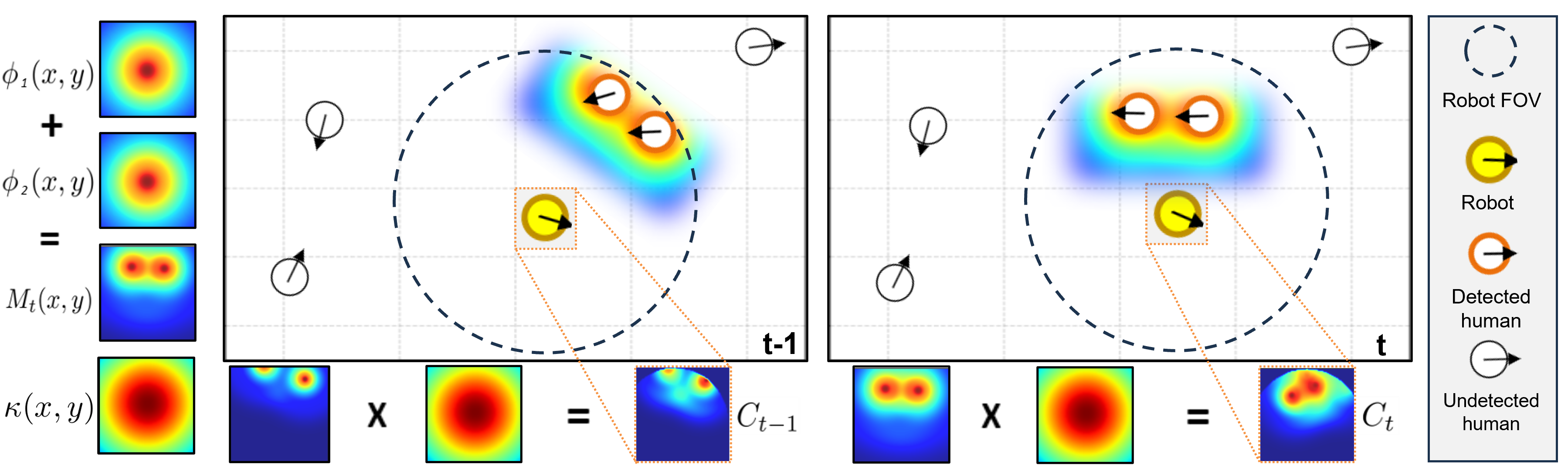
Detected humans generate individual proxemic fields φj(x,y), aggregated into a social cost map and locally weighted by a robot-centered kernel κ(x,y). The proxemic reward rprox,t is computed from the temporal difference of the resulting cost.
We integrate our proxemics-based reward Rp into two established DRL navigation methods (AttnGraph and MultiSoc) and compare against three baselines: no social reward (Base), a distance-based reward (Rd), and a velocity-based reward (Rv). Experiments are conducted in two crowd scenarios: Circle Crossing and Corridor, evaluated on both navigation metrics (success rate, collision rate) and social metrics (minimum distance, social compliance, time-to-collision, jerk).
Across all settings, Rp consistently yields the strongest gains on social metrics while remaining competitive on navigation performance. The robot maintains larger clearances from pedestrians, spends less time within intimate zones, and exhibits smoother trajectories, confirming that grounding the reward in proxemic zones provides a dense, informative learning signal that goes beyond collision avoidance.

Sample trajectories for AttnGraph (top row) and MultiSoc (bottom row) under Base, Rd, Rv, and Rp (left to right). Rp consistently selects wider, more peripheral passing arcs avoiding dense intersections of crowd flow.
@inproceedings{soualhi2026proxemics,
  author    = {Soualhi, Takieddine and Saraydaryan, Jacques and Matignon, Laetitia},
  title     = {Towards Socially Compliant Navigation in Deep Reinforcement Learning
               via Proxemics-Based Reward Modeling},
  booktitle = {IEEE/RSJ International Conference on Intelligent Robots and Systems (IROS)},
  year      = {2026},
}